
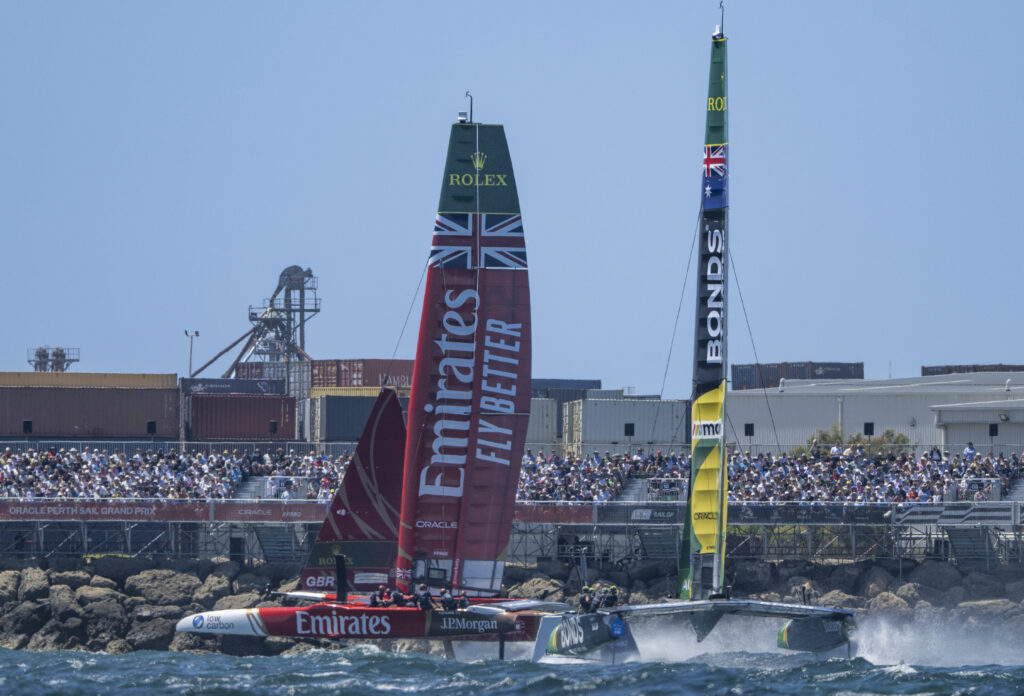
For millions of fans around the world, SailGP is all about speed, adrenaline and close racing. The championship’s fleet of identical F50 foiling catamarans regularly reaches speeds approaching 100 km/h, delivering one of the most spectacular events in modern sailing.
But while the racing lasts just minutes, the work behind it never stops.
Speaking on the Boatbuilding News Podcast ahead of SailGP Portsmouth, Hannah Manson, Head of People at SailGP, offered a rare insight into the operation behind one of the world’s fastest-growing sporting championships. Behind every race weekend is a global team of around 350 professionals, working across engineering, logistics, operations, technology, safety, event management and communications to ensure every event runs seamlessly.
As SailGP continues to expand its international calendar and global audience, the championship has become much more than a sailing competition. It is a showcase of marine engineering, operational excellence, teamwork and innovation, providing valuable lessons for the wider marine industry.
Industry Significance
Elite sailing has always relied on technical expertise, but SailGP has redefined what it means to operate a high-performance marine championship.
Unlike many sporting events, SailGP transports an entire global racing operation from venue to venue, requiring precision planning and flawless execution. Every stop on the calendar involves moving boats, race infrastructure, broadcast technology, safety equipment and hundreds of personnel across continents, all within incredibly tight timeframes.
While fans experience only a few hours of racing over a weekend, months of planning take place long before the first F50 enters the water.
“People often see the sailors crossing the finish line,”
Hannah Manson explained,
“but they don’t see the hundreds of people working behind the scenes to make that possible.”
Those people include engineers maintaining the F50 fleet, logistics specialists coordinating international freight, safety teams operating on the water, event managers overseeing race villages, and technical crews ensuring every aspect of the championship performs to the highest standard.
More Than Just Fast Boats
The F50 catamarans are among the most technologically advanced racing boats ever built.
Designed to foil above the water at remarkable speeds, every boat is maintained to an identical specification, placing greater emphasis on crew performance while demanding exceptional precision from the technical teams responsible for keeping them race-ready.
For SailGP’s engineers and technicians, every event presents a fresh challenge.
Repairs often need to be completed within extremely short timeframes, while detailed inspections and ongoing maintenance continue throughout each race weekend. Every component is monitored closely to ensure performance, reliability and safety remain uncompromised.
Behind the scenes, collaboration between departments is essential.
Rather than operating in isolation, engineering teams work alongside race management, logistics, operations and safety personnel, creating a highly integrated operation capable of responding quickly to changing conditions.
It’s this teamwork, Hannah Manson says, that enables SailGP to consistently deliver world-class events around the globe.
The Unsung Heroes of SailGP
Although the athletes naturally receive much of the public attention, Hannah Manson believes the success of SailGP is built on the expertise of the people working behind the scenes.
From logistics professionals coordinating equipment movements across continents to safety crews ensuring every race is conducted safely, every individual plays a critical role in delivering the championship.
“Everyone understands how their role contributes to the bigger picture”
she explained.
That shared sense of purpose creates a culture where collaboration becomes just as important as technical ability.
In such a fast-paced environment, adaptability is essential. Plans can change rapidly due to weather, technical issues or operational challenges, requiring teams to make decisions quickly while maintaining the highest standards of safety and performance.
Commercial Impact for the Marine Industry
The operational model behind SailGP offers valuable lessons for businesses across the wider marine sector.
Whether building yachts, manufacturing marine equipment or delivering complex refit projects, organisations increasingly rely on multidisciplinary teams capable of working together under pressure.
For Hannah Manson, technical expertise alone isn’t enough.
While specialist skills remain fundamental, she believes the qualities that truly define high-performing teams are attitude, resilience, curiosity and the ability to collaborate effectively.
These are increasingly important attributes as marine businesses navigate evolving technologies, sustainability requirements and growing international demand.
SailGP demonstrates that investing in people can be just as important as investing in technology.
Sustainability Driving Innovation
Alongside performance, sustainability continues to play an increasingly important role within SailGP’s long-term strategy.
The championship has committed to reducing its environmental impact while using elite sport as a platform to accelerate innovation across the wider marine industry.
For Hannah Manson, sustainability is not simply an initiative running alongside the racing—it is becoming embedded within how the championship evolves.
As materials, propulsion technologies and operational practices continue to develop, elite racing increasingly serves as a testing ground for ideas that may later influence commercial boatbuilding, yacht manufacturing and wider maritime operations.
For marine businesses watching the championship, the innovation taking place on and off the water provides valuable insight into where the industry is heading.
Portsmouth Takes Centre Stage
With SailGP returning to Portsmouth, one of Britain’s most historic maritime cities once again becomes the backdrop for world-class racing.
The event is expected to attract thousands of spectators while showcasing Portsmouth’s rich marine heritage to a global audience.
For local businesses, suppliers and marine professionals, hosting an international championship of this scale represents more than just a sporting event. It demonstrates the UK’s continued strength as a centre for marine innovation, engineering excellence and world-class event delivery.
Visitors attending SailGP Portsmouth will witness spectacular racing on the Solent, but as Hannah Manson highlights, there is an extraordinary operation unfolding behind the scenes that few ever get to experience.
What Happens Next
As SailGP continues expanding its global calendar, the operational demands behind the championship will only increase.
Delivering consistent, world-class events across multiple continents requires continuous investment in people, engineering, logistics and technology, while maintaining the agility to respond to new challenges at every venue.
For the wider marine industry, SailGP provides more than entertainment. It offers a real-world example of how collaboration, innovation and operational excellence can combine to deliver success on a global stage.
Boatbuilding News Analysis
SailGP has become synonymous with cutting-edge racing, but its greatest strength may lie behind the scenes. Hannah Manson’s insights reveal an organisation built on precision planning, technical excellence and exceptional teamwork—qualities that resonate far beyond elite sport. As the championship grows internationally, its influence on marine engineering, operations and innovation is likely to extend well beyond the racecourse, offering valuable lessons for the entire boatbuilding and maritime sector.