
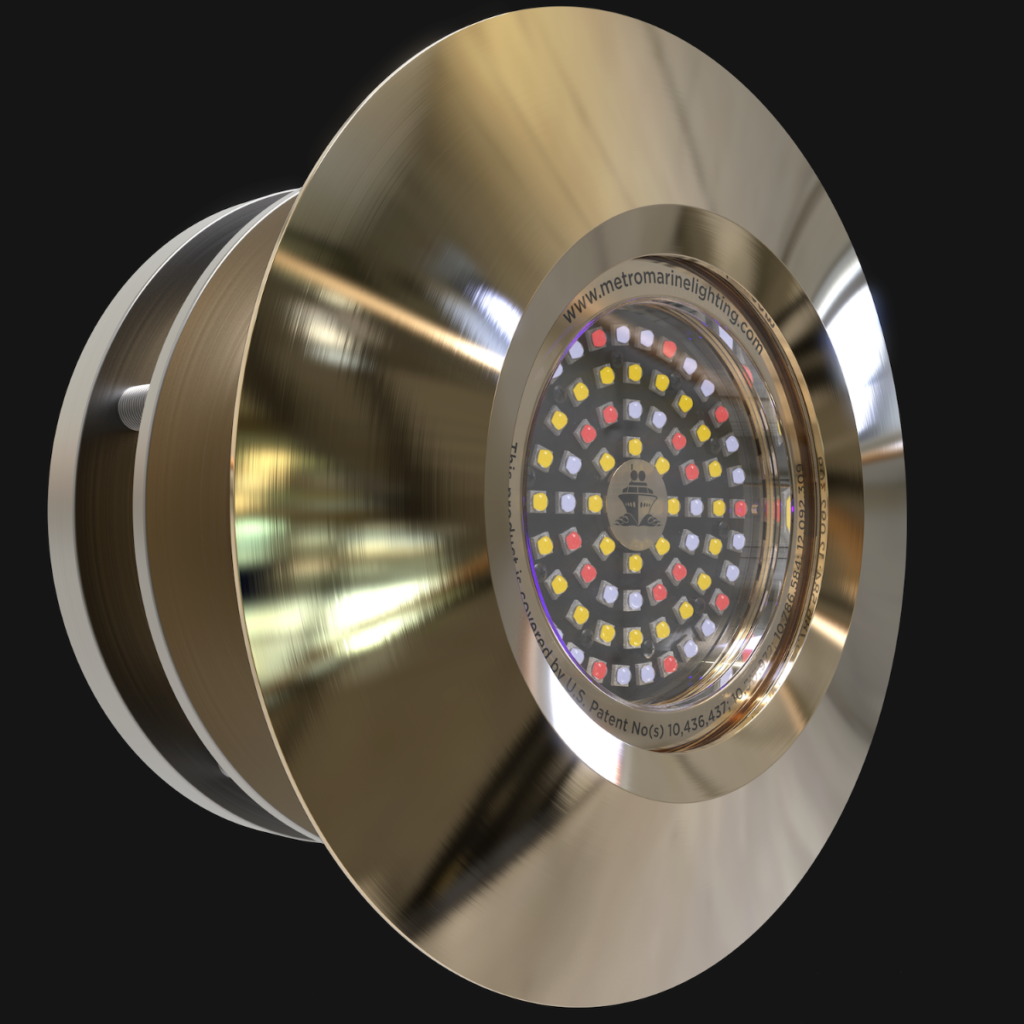
Metro Marine Lighting has introduced a new Full-Spectrum Thru Hull Light Fixture, targeting recreational and commercial vessels with a combination of high-output underwater illumination, RGBW colour performance and technologies designed to reduce two common problems in underwater lighting: marine growth and condensation.
The Englewood, New Jersey-based marine lighting specialist says the new fixture has been developed for flush-mounted thru-hull installation and is designed to maintain consistent performance during long-term submersion.
Industry Significance
Underwater lighting has become an increasingly established feature across the leisure marine sector, particularly on larger motor yachts, superyachts and performance-oriented vessels. However, underwater fixtures operate in a demanding environment where marine growth, water exposure, heat and internal condensation can affect both light output and service life.
Metro Marine Lighting’s latest fixture addresses these challenges through two patented technologies.
The first is the company’s UVC anti-biofouling technology, which is designed to prevent marine growth from accumulating on the fixture’s lens. Maintaining a clean lens can help preserve light output and potentially reduce the frequency of underwater maintenance.
The second is a patented assembly method intended to prevent internal condensation. Condensation can be particularly problematic for underwater lighting because repeated temperature changes and exposure to moisture can contribute to degradation of internal components and reduced optical performance.
Daniel Deutsch, President of Metro Marine Lighting, said the company had focused on addressing the practical challenges experienced by boat owners while combining them with full-spectrum RGBW performance.
High-Output RGBW Underwater Lighting
The new fixture uses Metro Marine Lighting’s Full-Spectrum RGBW technology, which differs from conventional RGB systems by incorporating a dedicated white-light source alongside red, green and blue channels.
According to the company, this enables dynamic colour blending while also producing a cleaner and higher-quality white light.
The fixture produces more than 15,500 lumens of white light output, while total fixture output exceeds 54,000 lumens. Metro Marine Lighting also highlights a close colour-mixing distance, designed to minimise visible separation between individual colours when the light is viewed underwater.
For yacht builders and owners, the combination of high output and full-spectrum control could provide greater flexibility when underwater lighting is integrated into wider exterior lighting schemes.
Rather than being limited to a single colour or basic RGB effects, the system is designed to deliver a broader range of colour and white-light options from the same fixture.
Designed for Long-Term Marine Exposure
The Full-Spectrum Thru Hull Light Fixture features an aluminium bronze housing, selected for durability in a permanently submerged marine environment.
Thermal monitoring is also incorporated into the fixture. Managing operating temperatures is particularly important for high-output LED lighting, where excessive heat can affect component life and reliability.
The fixture carries IP68 and IP9K ratings, reflecting its intended use in demanding marine conditions.
From an installation perspective, the unit is designed as a flush-mounted thru-hull fixture, making it suitable for integration into the hull rather than relying on an external surface-mounted arrangement.
This could make the product relevant to both new-build projects and selected refit applications where underwater lighting forms part of a broader exterior systems upgrade.
Integration With Onboard Electronics
The lighting system is designed to operate with Metro Marine Lighting’s Full Spectrum Hub and MM-CC-V1 Control Center, creating a common power and data architecture for controlling lighting across a vessel.
The control platform is also Garmin OneHelm and NMEA 2000 certified, allowing the lighting system to interface with modern onboard electronics.
For boatbuilders and systems integrators, this type of integration is increasingly important as yachts move towards centralised digital control architectures.
Instead of treating underwater lighting as an isolated electrical installation, integration with onboard networks can allow it to become part of a vessel-wide lighting and control strategy.
Commercial Impact
For shipyards, yacht builders and marine electrical contractors, reliability and maintenance requirements are important considerations when selecting underwater lighting.
Fixtures that require regular cleaning or replacement can create additional maintenance costs, particularly on larger vessels where access to underwater equipment may require specialist facilities or lifting operations.
Metro Marine Lighting’s anti-biofouling technology is therefore a potentially significant aspect of the new product from an operational perspective. If the technology performs as intended over extended service periods, reducing marine growth could help maintain consistent illumination while reducing intervention requirements.
The company’s approach also reflects a wider trend towards combining higher-performance lighting with smarter monitoring and control systems.
Market Context
The underwater lighting market spans everything from smaller recreational boats to large superyachts and commercial vessels. Demand is increasingly shaped by both aesthetics and systems integration, with lighting becoming part of the overall onboard electronics and exterior design package.
For yacht designers and naval architects, the ability to integrate lighting controls into existing vessel networks can simplify the user experience and provide greater control over lighting environments.
For builders, meanwhile, the combination of flush installation, network integration and high output creates a product specification that can be considered during the design stage rather than added as a standalone decorative feature later in the build process.
What Happens Next
Metro Marine Lighting says the Full-Spectrum Thru Hull Light Fixture is protected by multiple US and international patents, with additional patents pending.
The key question for the market will be how the fixture performs over extended periods in real-world marine environments, particularly regarding biofouling resistance, thermal management and long-term reliability.
Performance in these areas will be particularly relevant to commercial operators and yacht owners looking to minimise maintenance requirements while maintaining high-quality underwater illumination.
Boatbuilding News Analysis
Metro Marine Lighting’s new fixture reflects the continued evolution of underwater lighting from a primarily aesthetic product into a more integrated marine technology system. The combination of RGBW full-spectrum output, anti-biofouling technology, condensation prevention, thermal monitoring and NMEA 2000 integration addresses several practical considerations for modern vessels. For builders and systems integrators, the most significant development may be the move towards underwater lighting that is designed around reliability and onboard connectivity as much as visual impact.