
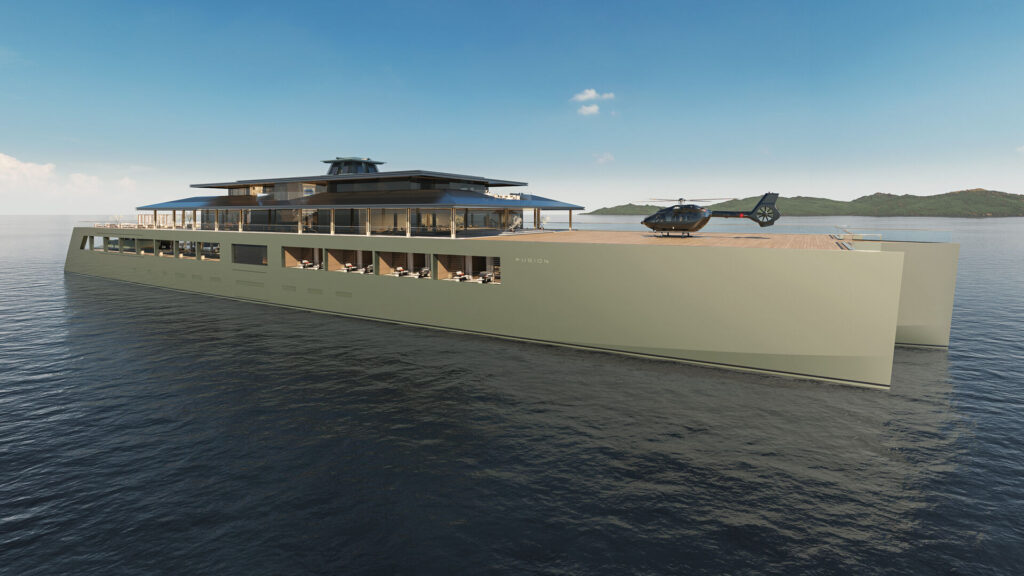
Sinot Yacht Architecture & Design has unveiled Fusion, a 118-metre trimaran superyacht concept built around three near-full-length hulls and an extraordinary 30-metre beam.
Described by Sinot as the world’s largest full-length trimaran superyacht concept, Fusion uses a 115-metre centre hull accompanied by two 110-metre side hulls rather than conventional shorter outriggers. The arrangement creates a single expansive platform offering approximately 3,340 square metres of exterior deck space.
Naval architecture has been developed by Azure Yacht Design & Naval Architecture, while Sinot is responsible for the yacht’s exterior architecture and interior design.
The studio says Fusion has been developed as a ready-to-build concept, although a shipyard has not yet been announced.
Three full-length hulls redefine the superyacht platform
The defining feature of Fusion is not simply that it is a trimaran, but the proportions of its three hulls.
The centre hull measures approximately 115 metres at the waterline with a 17.5-metre beam, while each side hull extends for approximately 110 metres and measures 4.7 metres across.
This is an important distinction from trimarans where shorter outer hulls primarily provide stability.
“Fusion is not a standard yacht with extra stabilisers,” explained Sander J. Sinot of Sinot Yacht Architecture & Design.
“Three near-full-length hulls come together as one architecture, and that changes what is possible aboard a yacht of this size.”
The resulting 30-metre overall beam gives the designers an unusually large horizontal platform on which to arrange accommodation, recreation and technical areas.
For naval architects and shipyards, however, translating that width into a buildable yacht creates an entirely different set of structural, hydrodynamic and systems-integration challenges from a conventional monohull.
Fusion offers 3,340sqm of exterior deck space
One of the most striking consequences of the trimaran configuration is the amount of available exterior space.
Sinot says Fusion provides around 3,340 square metres of exterior decks, with approximately 2,200 square metres concentrated on the upper deck alone.
Forward is a 770-square-metre ‘Playdeck’, designed as a flexible recreational area.
The space could accommodate a full-size tennis court as well as futsal, volleyball, BMX activities and events. When not being used recreationally, the same area has been conceived to support helicopter and VTOL aircraft operations.
At the opposite end of the upper deck is a 970-square-metre aft terrace centred around a swimming pool measuring approximately 8.2 by 12.7 metres. The pool incorporates a glass bottom overlooking the deck below.
Rather than simply creating larger versions of conventional yacht spaces, the 30-metre beam allows different functions to operate alongside one another.
843sqm deck dedicated to tenders and equipment
Fusion also pushes the superyacht’s role as a mobile exploration platform significantly further.
An 843-square-metre area on the main deck is dedicated to tenders, watercraft, vehicles and specialist equipment.
The proposed inventory includes four tenders measuring around 15 metres, including two limousine tenders, alongside diving equipment and expedition vehicles. The design also allows for equipment such as submersibles and small aircraft.
Integrated mobile cranes would be used to launch and recover equipment.
This reflects a broader development within the very-large-yacht market, where the mothership increasingly operates as a base for a fleet of tenders, aircraft, submarines and specialist exploration equipment.
Fusion’s trimaran architecture provides substantially more deck area with which to accommodate those functions.
8,200 GT yacht designed for just 18 owners and guests
Despite its scale, Fusion has been conceived for a comparatively small number of guests.
The concept is estimated at approximately 8,200 GT, yet accommodation is planned for just 18 owners and guests, supported by as many as 49 crew and staff.
The owner’s accommodation occupies the aft section of the upper deck and includes a private terrace measuring around 100 square metres.
Eight further guest cabins are positioned on the main deck.
Wellness is another major element of the design. A roughly 300-square-metre spa includes a Turkish bath, sauna, massage and treatment spaces, cold plunge pool and relaxation areas.
A separate fitness centre incorporates a counter-current pool, gym equipment, physiotherapy facilities and outdoor space for yoga and Pilates.
Ready to build, but major engineering questions remain
Sinot describes Fusion as a ready-to-build and fully operational concept, meaning the overall platform, structural principles and general arrangement have been developed beyond a purely conceptual design exercise.
However, several important technical specifications have not yet been disclosed.
No shipyard has been announced, while details covering propulsion, construction materials, power output, draught, maximum speed, cruising range and fuel capacity remain undisclosed.
These specifications will ultimately determine how the concept’s ambitious architecture translates into a functioning 118-metre vessel.
For the boatbuilding industry, a three-hull yacht of this scale would create significant demands across structural engineering, propulsion, electrical generation, HVAC, stabilisation, machinery, glazing, deck equipment and onboard systems.
What happens next for Fusion?
The next major milestone would be securing an owner and selecting a shipyard capable of engineering and constructing the platform.
Very few facilities globally have the infrastructure, engineering capability and project management resources required for an 8,200 GT yacht measuring 118 metres long and 30 metres across.
Should Fusion progress into construction, the detailed engineering phase would therefore be particularly significant, providing greater insight into how the three near-full-length hulls influence propulsion, efficiency, structural loading and vessel operation.
Boatbuilding News Analysis
Fusion’s most important number may not be its 118-metre length, but its 30-metre beam. Three near-full-length hulls create more than 3,300 square metres of exterior space and fundamentally change how designers can distribute guest, recreational and technical functions across a yacht. The concept is ambitious, but its real significance for boatbuilding will become clearer if an owner and shipyard take it into detailed engineering and construction.